Skip to main content Skip to footer content
    • See All
    • Jewelry
    • Handbags
    • Accessories
    • Watches
    • See All
    • Best sellers
    • Engraved jewelry
    • CATEGORIES

    • Earrings
      • See All
      • BY STYLE

      • Small earrings
      • Long earrings
      • Hoop earrings
      • Bear earrings
      • BY MATERIAL

      • Gold earrings
      • Silver earrings
      • Gold-plated earrings
      • Earrings with pearls
      • Earrings with gemstones
      • Earrings with diamonds
    • Bracelets
      • See All
      • BY STYLE

      • Chain bracelets
      • Bangles
      • Cord and thread bracelets
      • Ball bracelets
      • Bear bracelets
      • BY MATERIAL

      • Silver bracelets
      • Gold-plated bracelets
      • Gold bracelets
      • Bracelets with pearls
      • Bracelets with gemstones
      • Bracelets with diamonds
    • Necklaces
      • See All
      • BY STYLE

      • Short necklaces
      • Long necklaces
      • Chains
      • Bear necklaces
      • BY MATERIAL

      • Silver necklaces
      • Gold-plated necklaces
      • Gold necklaces
      • Necklaces with pearls
      • Necklaces with gemstones
      • Necklaces with diamonds
    • Rings
      • See All
      • BY STYLE

      • Fine rings
      • Large rings
      • Medium rings
      • Open rings
      • Bear rings
      • Signet rings
      • Solitaire rings
      • Engagement rings
      • BY MATERIAL

      • Gold rings
      • Silver rings
      • Gold-plated rings
      • Diamond rings
      • Rings with gemstones
      • Pearl rings
    • Pendants
      • See All
      • BY STYLE

      • Bear pendants
      • Heart pendants
      • Pendants with initial
      • Small pendants
      • Medium pendants
      • Large pendants
      • BY MATERIAL

      • Gold-plated pendants
      • Silver pendants
      • Gold pendants
      • Pendants with pearls
      • Pendants with gemstones
      • Pendants with diamonds
    • Piercings
    • Charms
    • MATERIALS

    • Sterling silver jewelry
    • Gold-plated jewelry
    • Jewelry in gold
    • Jewelry with pearls
    • Jewelry with gemstones
    • Jewelry with diamonds
    • TOUS Lab Diamond Jewelry
    • See All
    • Best sellers
    • Leather handbags
    • Handbags made of raffia
    • Crossbody bags
    • Tote bags
    • Small and mini handbags
    • Audree handbags
    • Backpacks and luggage
    • Shopping bags
    • Bowling bags
    • Customizable handbags
    • See All
    • Wallets and change purses
    • Scarves and foulards
    • Sunglasses
    • Key rings and charms for handbags
    • Hats and scarves
    • Other accessories
    • See All
    • Best sellers
    • Watches for women
    • Watches for men
    • Smartwatches
    • Analog watches
    • Digital watches
  • TOUS Atelier
    • See All
    • Gifts for her
    • Gifts for him
    • First Communion
    • Engagement rings
    • Birthday gifts
    • See All
    • About us
    • Jewelry Guide
WE SPEAK JEWELRY
METALS
GEMSTONES
Diamonds
Pearls
PRODUCTION TECHNIQUES
QUALITY CERTIFICATES
Metals
Gemstones
Diamonds
Pearls

PEARLS

Pearls are gemstones of organic, origin. We differentiate between natural and cultivated pearls based on whether man has been involved or not. The typical pearly luster is produced by the overlapping platelets of aragonite and film of conchiolin nearer of the pearl surface. This formation also causes the interference of light and the resulting iridescent colors, called orient that can be observed in the pearls surface.Known for men since roman times, due that pearls do not need to be polished or cut to show it´s beauty.

NATURAL PEARLS

NATURAL PEARLS

NATURAL PEARLS

Natural Pearls are made by a mollusk as a defensive action resulting from the intrusion of a foreign body. They are opaque and can come in a myriad of shapes and colors. They are made of a fragile material as their structure is made of organic material and water. For this reason, we recommend that they do not come into contact with dryness, perfumes, sweat or other pearls. They should also be worn only on occasion and should be aired well.

CULTURED PEARLS

CULTURED PEARLS

CULTURED PEARLS

Most pearls that are currently sold are cultivated, since over-fishing natural riverbeds has caused many of them to run out. All the pearls we use at TOUS are cultured. They are formed by mollusks in a way that is almost identical to natural ones. The only difference is that an artificial core is manually inserted into a mollusk so that this begins to secrete nacre. The value of cultivated pearls is dependent upon quality factors, such as shine, surface condition, shape, color and size. Depending on the varieties and where they are produced, we differentiate between:

CULTURED SALTWATER PEARLS

CULTURED SALTWATER PEARLS

CULTURED SALTWATER PEARLS

Cultured saltwater pearls have their origin in Japan, where the Japanese introduced their culturing systems in Micronesia, in the Palau Islands, when these were under their protectorate during the period between the two world wars. Cultured saltwater pearls are formed in various species of marine bivalve mollusks or pearl oysters. As a rule, a saltwater oyster can only produce one or two pearls per shell. Each oyster is nurtured throughout its life cycle on the farm and cleaned regularly to ensure that it remains in good health. At present, pearl farms are to be found in the South Seas, an area stretching from Australia to the Indian Ocean, the French Polynesian atolls, Australia, Indonesia, Japan and the Gulf of Mexico.

1. AUSTRALIAN OR SOUTH SEA PEARLS

1. AUSTRALIAN OR SOUTH SEA PEARLS

1. AUSTRALIAN OR SOUTH SEA PEARLS

They generally range in size between 10 and 20 millimeters of diameter and are produced in the largest mollusk, the Pinctada Máxima. The cultivation period is nearly 3 years.
 
DID YOU KNOW THAT...?
 
They are known as the “queen of the pearls” due to their large size and their unmatched beauty. They can come in a range of shapes, but are usually rounded although baroque shapes are also well desired.
 
ORIGIN
 
Northern Australia, area around the Philippines, Indonesia.
They generally range in size between 10 and 20 millimeters of diameter and are produced in the largest mollusk, the Pinctada Máxima. The cultivation period is nearly 3 years.
 
DID YOU KNOW THAT...?
 
They are known as the “queen of the pearls” due to their large size and their unmatched beauty. They can come in a range of shapes, but are usually rounded although baroque shapes are also well desired.
 
ORIGIN
 
Northern Australia, area around the Philippines, Indonesia.
They generally range in size between 10 and 20 millimeters of diameter and are produced in the largest mollusk, the Pinctada Máxima. The cultivation period is nearly 3 years.
 
DID YOU KNOW THAT...?
 
They are known as the “queen of the pearls” due to their large size and their unmatched beauty. They can come in a range of shapes, but are usually rounded although baroque shapes are also well desired.
 
ORIGIN
 
Northern Australia, area around the Philippines, Indonesia.

2. MABE PEARL

2. MABE PEARL

2. MABE PEARL

Cultivated semi-spherical pearls that grow attached to the inside of an oyster shell, instead of inside its body. They are produced in sizes that range from 10 to 17 mm in diameter.
 
DID YOU KNOW THAT...?
 
When the hemispheric pearl has been covered in with nacre, it is cut, the nucleus is eliminated, the hole is filled, and a mother-of-pearl base is incorporated. 
 
ORIGIN
 
Japan, Indonesia, Australia.
Cultivated semi-spherical pearls that grow attached to the inside of an oyster shell, instead of inside its body. They are produced in sizes that range from 10 to 17 mm in diameter.
 
DID YOU KNOW THAT...?
 
When the hemispheric pearl has been covered in with nacre, it is cut, the nucleus is eliminated, the hole is filled, and a mother-of-pearl base is incorporated. 
 
ORIGIN
 
Japan, Indonesia, Australia.
Cultivated semi-spherical pearls that grow attached to the inside of an oyster shell, instead of inside its body. They are produced in sizes that range from 10 to 17 mm in diameter.
 
DID YOU KNOW THAT...?
 
When the hemispheric pearl has been covered in with nacre, it is cut, the nucleus is eliminated, the hole is filled, and a mother-of-pearl base is incorporated. 
 
ORIGIN
 
Japan, Indonesia, Australia.

CULTIVATED FRESH WATER PEARLS

CULTIVATED FRESH WATER PEARLS

CULTIVATED FRESH WATER PEARLS

Pearls cultivated in pearl farms, which can be found in rivers, bays and lakes all over the world. They are easily cultivated in freshwater molluscs, though as salt water cultivated pearls.
DID YOU KNOW THAT...?
The Japanese began to experiment with freshwater mussels and came to the conclusion that inserting cores was not necessary, only a small pieces of mantle was needed to get the cultivation process started. 
ORIGIN
China, Japan, USA.
Pearls cultivated in pearl farms, which can be found in rivers, bays and lakes all over the world. They are easily cultivated in freshwater molluscs, though as salt water cultivated pearls.
DID YOU KNOW THAT...?
The Japanese began to experiment with freshwater mussels and came to the conclusion that inserting cores was not necessary, only a small pieces of mantle was needed to get the cultivation process started. 
ORIGIN
China, Japan, USA.
Pearls cultivated in pearl farms, which can be found in rivers, bays and lakes all over the world. They are easily cultivated in freshwater molluscs, though as salt water cultivated pearls.
DID YOU KNOW THAT...?
The Japanese began to experiment with freshwater mussels and came to the conclusion that inserting cores was not necessary, only a small pieces of mantle was needed to get the cultivation process started. 
ORIGIN
China, Japan, USA.

1. ROUND

1. ROUND

1. ROUND

Cultured freshwater pearls without an artificial core inside; they are symmetrical and roll in a straight line. This is generally the most highly prized type of pearl. At TOUS, the most frequently used sizes are between 4 and 9 mm.

2. HALF-ROUND

2. HALF-ROUND

2. HALF-ROUND

A cultured freshwater pearl without an artificial core inside. They have a rounded shape but do not achieve a completely spherical shape. The sizes are similar to those of the round pearl.

3. BUTTON

3. BUTTON

3. BUTTON

A cultured freshwater pearl without an artificial core inside, symmetrical but flattened in a particular area. At TOUS, they are commonly used for bracelets and necklaces. There is a wide selection of sizes ranging between 4 to 10 mm.

4. COIN

4. COIN

4. COIN

A cultured freshwater pearl with an artificial core inside. The flat shape is due to shape of the artificial core itself that is inserted into the mollusk. The average size is usually 10-12 mm, but we have collections at TOUS where they can reach 16-17 mm. Irregularities in the shape or surface are possible.

5. STICK

5. STICK

5. STICK

A cultured freshwater pearl without an artificial core inside. Its characteristic elongated shape is achieved by the shape of the fabric that is inserted to stimulate the mollusk’s secretion of nacre. The cultivation time is between 1 and 2 years. The sizes vary: between 12-22 mm.

6. RICE GRAIN

6. RICE GRAIN

6. RICE GRAIN

A cultured freshwater pearl without an artificial core inside. Its size of only a few millimeters and its elongated, irregular shape are reminiscent of a grain of rice, hence its name.

7. BAROQUE

7. BAROQUE

7. BAROQUE

A cultured freshwater pearl with or without an artificial core inside. Its irregular, asymmetric shape is dependent upon a variety of factors, such as climate or the quality of the water where the mollusk lives. The cultivation time is 2 years.
SYMBOLOGY
INNOCENCE: Due to their delicate nature, pearls have traditionally been associated with purity and innocence. They are often worn as charms for protection against evil and for good luck.
DUE TO THEIR DELICATE NATURE, PEARLS HAVE TRADITIONALLY BEEN ASSOCIATED WITH PURITY AND INNOCENCE.

PRODUCTS WITH PEARLS

View all
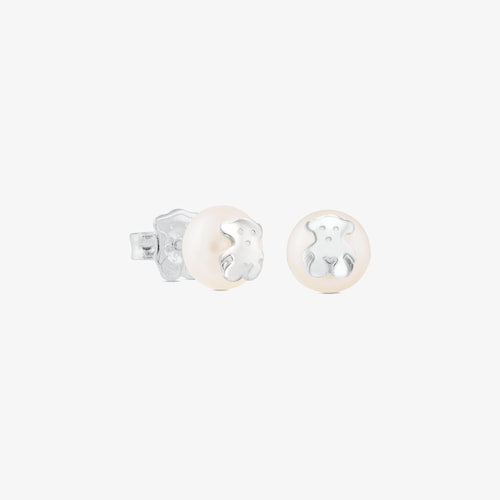
Silver TOUS Bear Earrings with pearls
Previous Next

Silver TOUS Bear Earrings with pearls

99,00 €
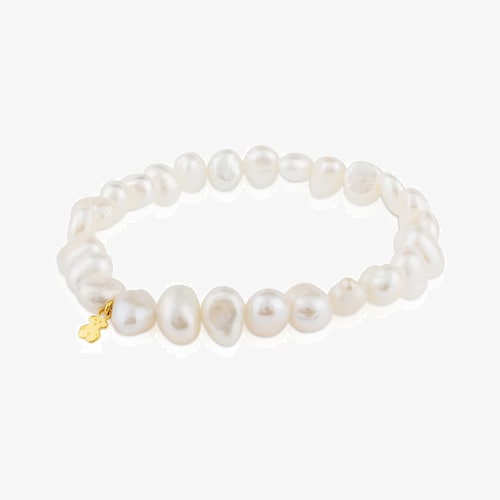
18K solid gold Sweet Dolls Bracelet with baroque pearls and Bear motif
Previous Next

18K solid gold Sweet Dolls Bracelet with baroque pearls and Bear motif

95,00 €
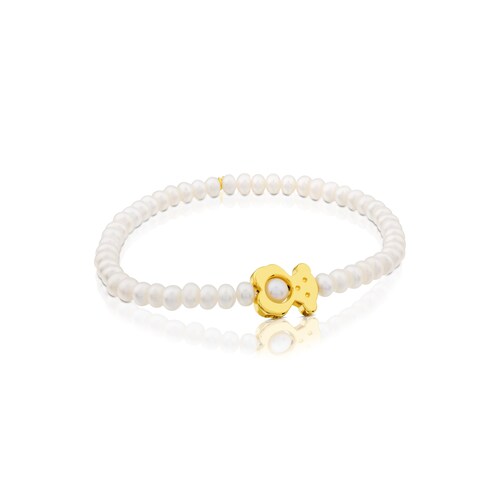
18K Solid Gold Sweet Dolls Bracelet
Previous Next

18K Solid Gold Sweet Dolls Bracelet

N/A
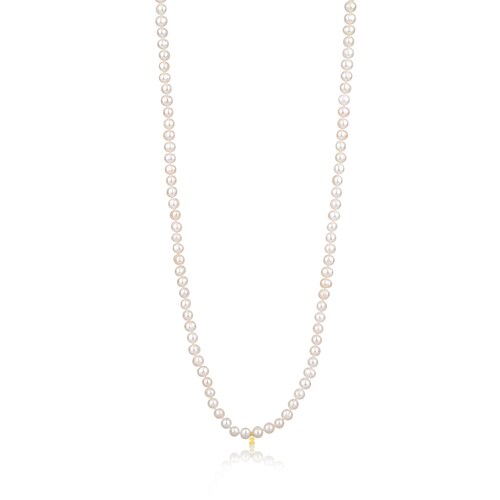
18K Solid Gold TOUS Pearls Necklace
Previous Next

18K Solid Gold TOUS Pearls Necklace

N/A
View all

Newsletter

Join our newsletter and get a 10% discount off your first purchase!

By clicking Sign Up, you agree to TOUS Terms & Conditions and Privacy Policy, and consent to receive marketing communications from TOUS

By clicking Sign Up, you agree to TOUS Terms & Conditions and Privacy Policy, and consent to receive marketing communications from TOUS

Thank you for subscribing!

Welcome! You will soon start receiving our new arrivals

TOUS logo

© TOUS, jewelers since 1920

Facebook
Tiktok
Pinterest
X
Youtube
Instagram
CUSTOMER SERVICE
  • Customer Service
  • Shipping
  • Returns
ABOUT US
  • Corporate culture
  • TOUS Heritage
  • Headquarters
  • Work with us
JEWELRY GUIDE
  • Gem guide
  • Metal guide
  • Gem guide
  • Diamond guide
  • Pearls guide
  • Production techniques
  • Certificates of Quality
  • Terms of use
  • Use and privacy policy
  • Cookies policy
  • Legal warning
  • Ethical code
  • Supplier Ethical Code
  • Ethical channel
  • Provisional Accessibility Statement
Newsletter

Join our newsletter and get a 10% discount off your first purchase!

By clicking Sign Up, you agree to TOUS Terms & Conditions and Privacy Policy, and consent to receive marketing communications from TOUS

Thank you for subscribing!

Welcome! You will soon start receiving our new arrivals